
More Than a Road: Rebuilding Trust Between Mershing and East Jebel Marra

East Jebel Marra, South Darfur — 2026
There is a road in South Darfur that connects two worlds.
On one side, the highlands of East Jebel Marra: a fertile mountain territory, rich in fruit and agricultural produce, home to communities that have farmed these lands for generations. On the other, the lowlands of Mershing: a bustling trade hub where goods move, markets thrive, and people from across the region converge.
For the communities on both sides, this road is not just a route. It is the artery of daily life. Farmers bringing produce down from the mountain. Traders carrying goods back up. Families visiting one another. Children reaching schools and clinics that would otherwise be unreachable.
For more than a year, this important road has been closed.
For Concordis, understanding why this road remained closed became the starting point for supporting a community-led process to reopen it.
A fragile border
The road runs through a border zone where two different armed authorities meet, one of South Darfur's most complex landscapes. The highlands are controlled by the Sudan Liberation Movement/Army (SLA - Abdul Wahid), whereas the lowlands fall under the Rapid Support Forces (RSF). In between, communities have long navigated this divide, trading across it, living alongside it, making it work.
But that balance is fragile. When violence occurs on one side of the boundary, accountability is almost impossible. Armed actors from one territory cannot cross into the other to investigate or enforce. The gap between the two creates space for criminality, and when crimes go unresolved, communities take matters into their own hands.
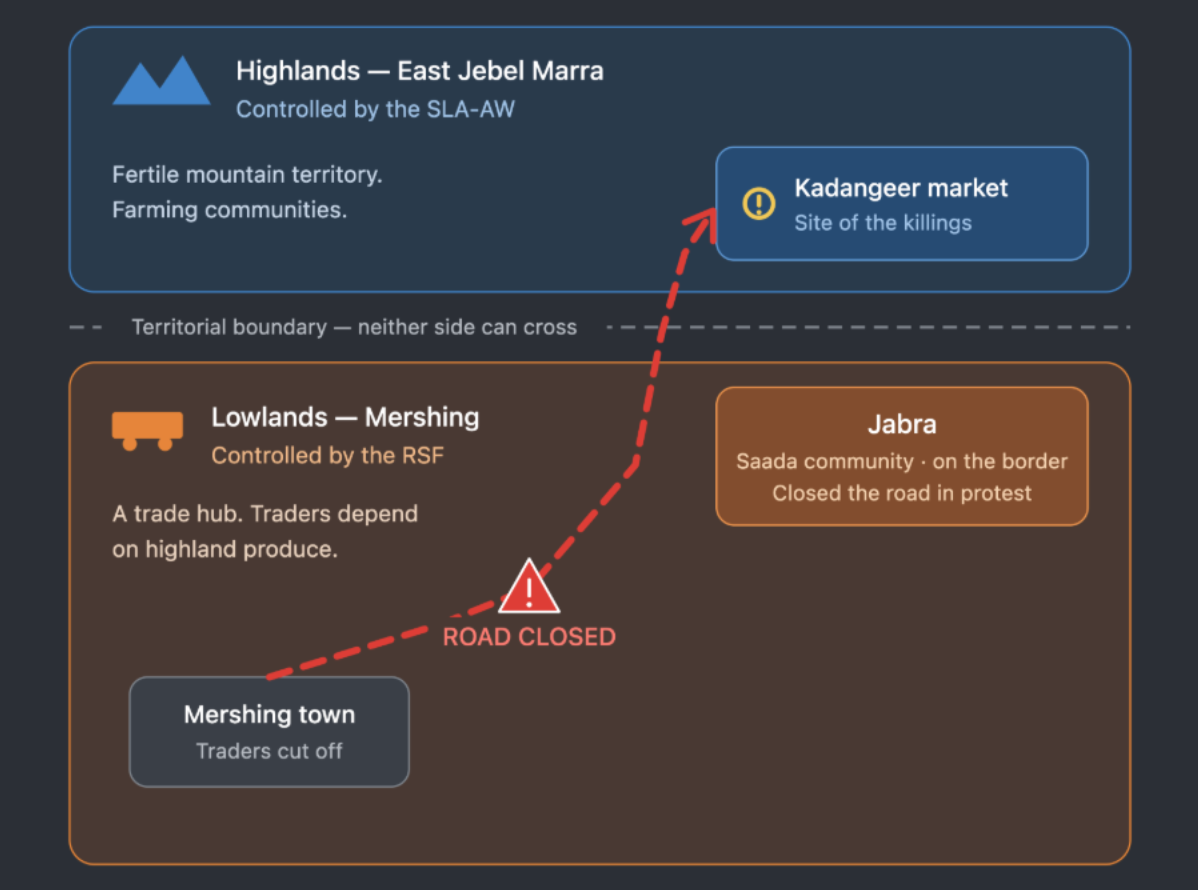
What closed the road
Around a year ago, members of the Saada Arab community, whose territory sits at the border between the two zones, were killed at Kadangeer market. The violence was devastating, and the response from the wider community was immediate.
A compensation process was set in motion. A committee was formed. Blood money was agreed and paid.
But it never reached the families it was meant for.
The committee responsible for distributing the compensation failed to deliver it in full. The families of the victims, already grieving, found themselves cheated by the very process that was supposed to deliver them justice. Looted property remained unaccounted for. Outstanding debts went unpaid.
In response, the Saada community closed the road.
It was the only leverage they had.
The cost of closure
The irony is painful. The communities who closed the road are among those suffering most from its closure.
Transport costs tripled almost overnight from 10,000 to 30,000 Sudanese pounds. Traders from Mershing lost access to Kadangeer market. Farmers in the highlands lost access to the lowland buyers they depended on. Humanitarian services, already stretched thin across the region, became harder to deliver. Even market days shifted to adapt to the new reality, creating new overlaps and tensions that compounded the disruption further.
The road is one of the main links between agricultural producers in East Jebel Marra and the markets of Mershing and Nyala. When it closed, both communities lost access to trade, income, and essential services.
Both sides of the boundary feel it. Mountain communities and lowland communities alike have seen their livelihoods disrupted, their markets weakened, and their connections to one another frayed.
This is not a dispute between enemies. These are communities that need each other and know it.
Going to listen
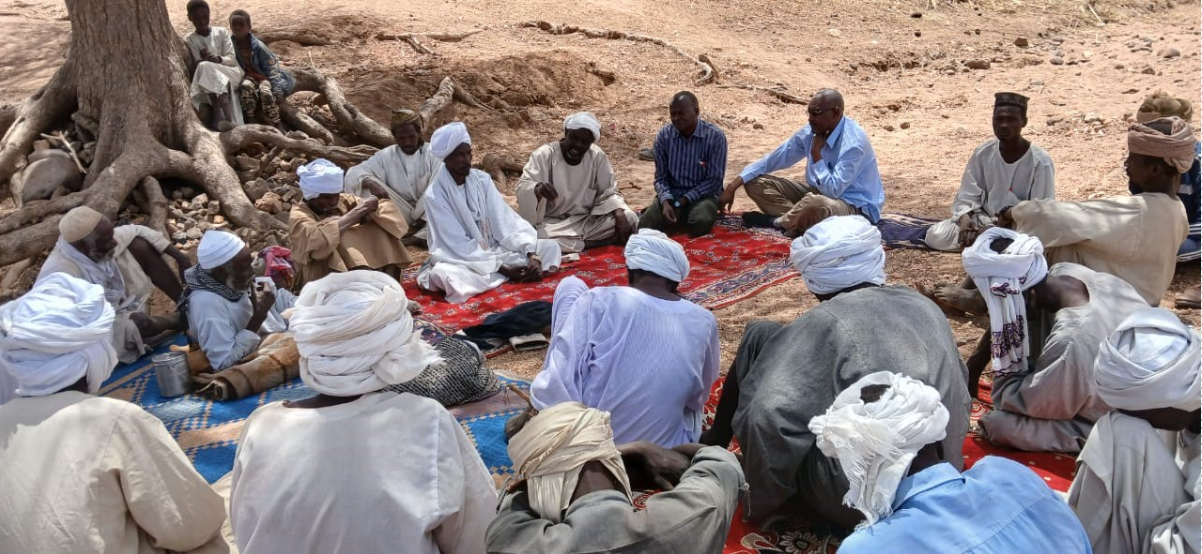
Concordis meets with the Nazir of the Saada tribe and community leaders in Gardood, South Darfur, to discuss the road closure between Jabra and Kadangeer — March 2026.
Rather than beginning with solutions, Concordis began by listening. In late March 2026, the team travelled to Mershing, Al Malam, Gardood, and Jabra to understand how communities viewed the road closure and what they believed was needed to resolve it.
What we found was a community in pain, but not without hope. Across every meeting, with traditional leaders, traders, transport workers, and local authorities, the message was consistent: everyone wants the road open. The question is how to get there without reopening the wounds.
Community members and local authorities repeatedly noted that the compensation process needs to be completed with integrity and accountability. The overlapping market days that are creating unnecessary friction need to be resolved. And the coordination gap between the two armed authorities, which allows crimes to go unpunished and grievances to fester, needs to be addressed.
But perhaps the most important finding was this: the communities already know who they trust to help them get there.
The mediator everyone agrees on
Across every meeting, one name came up consistently: the Prince of Kass with the support of Concordis.
A senior traditional leader with deep roots across the region, the Prince of Kass is respected by all sides, including both armed authorities. He is seen not as an outsider imposing solutions, but as someone who understands the landscape, the people, and the stakes.
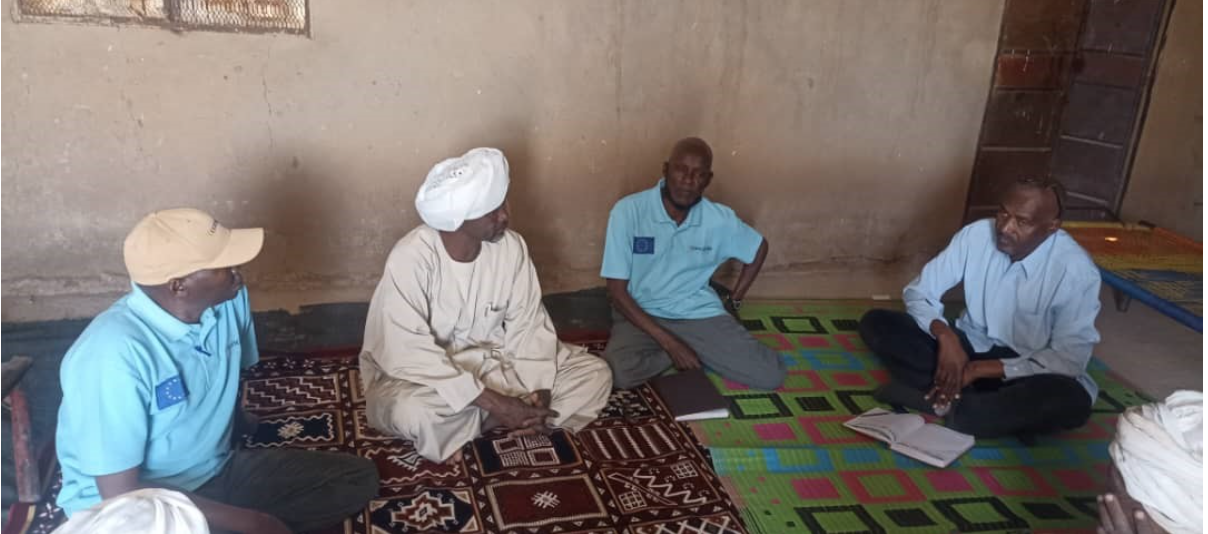
Concordis meets with community leader in Jabra, the border area at the heart of the road closure, South Darfur — March 2026.
Based on recommendations from communities and local leaders, Concordis is supporting the mediation efforts of the Prince of Kass, whose longstanding relationships across the region place him in a unique position to facilitate dialogue.
The next step is for him, flanked by Concordis's Advisory Groups on the ground, to travel to the area and meet directly with leaders from both sides, including armed actors, to begin conversations that could lead to the road reopening.
The road is not open yet. But the right person is now stepping in, with the trust of the communities behind him.
What this work looks like
Sustainable solutions to road closures in contexts like this one do not come from external pressure or top-down enforcement. They come from within, from trusted figures, community-led processes, and the careful, patient work of rebuilding enough trust that people feel safe to move forward.
That is what Concordis is supporting here. Not imposing a timeline. Not claiming outcomes that haven't happened yet. But creating the conditions, the conversations, the mediators, the structures, that make a lasting resolution possible.
In East Jebel Marra, the road that connects everything has been closed for too long. The communities on both sides know what they stand to lose if it stays that way.
The road remains closed, but the conversations have begun. If communities continue to lead the process, supported by trusted local leaders, there is renewed hope that this vital connection between East Jebel Marra and Mershing will reopen, not only restoring movement but rebuilding trust between neighbours.
This document has been produced with the financial assistance of the European Union. The contents of this document are the sole responsibility of Concordis International and can under no circumstances be regarded as reflecting the position of the European Union.