
Sudan is experiencing its worst hunger crisis in decades. According to the World Food Programme, approximately half of Sudan’s population of 50 million people are facing extreme levels of hunger. Famine is confirmed in several parts of the country.
When civil war broke out in Sudan on 15 April 2023, food production began to collapse. Few people plant crops while war is raging. Those who tried were forced to flee their land, leaving fields untended and harvests lost. The longstanding Talaga system, which governs rhythms of cooperation between farmers and herders, also broke down.
The result was a failed harvest in 2023.
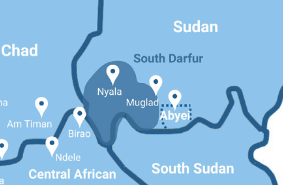
At the same time, ethnic divisions in South Darfur were being deliberately exploited for political gain, echoing patterns seen during the genocide in 2003. History was repeating itself. Food, hunger, and aid were increasingly used as weapons of war.
Without resilience to conflict, without some way to resolve conflict very fast, every fight between individuals of different ethnic groups has the potential to escalate quickly into something very dangerous.
If people can’t grow food, graze cattle and take their produce to market, they will starve to death.
How Concordis Makes a Difference
The midst of a war is not the time to resolve generations-old land conflicts. Nonetheless, the avoidance of starvation and genocide is a strong incentive, and the Concordis team worked tirelessly with traditional leaders and other members of the Advisory Groups in South Darfur to negotiate a pragmatic set of local-level peace agreements.
Through a series of dangerous and difficult peace talks, communities in conflict were helped to agree:
Who should be permitted to plant certain fields, and where cattle should have access to pasturage, to ensure crops were kept safe to harvest and livestock had access to water without conflict.
How intercommunity conflicts should be resolved speedily, before they escalated into mass-killings.
How markets and roads could be kept open, to ensure different ethnic groups were safe to trade and food could reach those who were hungry. This laid the groundwork for farming, grazing and trade to happen peacefully. Now it needed people, and particularly young men, to farm.
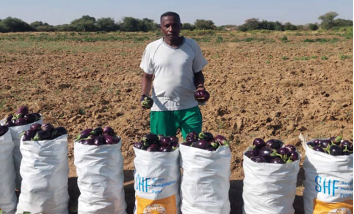
Our peacebuilders had a simple message:
"Do not send your son to war, send him to the fields."
If the young men want to be protectors and defenders of their clan, they need to grow food and build livelihoods. This shift towards farming over fighting has helped communities protect their livelihoods and feed their families, even as war continues.
Concordis Programme Officer Khalid Adam tells us:
“I witnessed farmers helping each other during the harvest season in a traditional practice called Al Nafeir, where groups come together to assist one another. People were overjoyed, thanking God for the abundance and success of the harvest.”
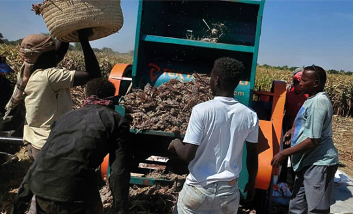
In all 14 districts where we ran our peacebuilding activities, the 2024 harvest came in at between 7095% of pre-war levels.
Families had enough to use a third to feed themselves, a third cached for the next year’s seed stocks, and a third to sell at market. The price of sorghum in the market fell from 35 Sudanese Pounds (4.5 pence) per scoop to just 5 pounds, making it affordable for ordinary families again.
The dependency on aid is reduced, and self-reliance is restored. Thanks to the work of peacebuilders, South Darfur will not be in famine this year.
This success story provides us with hope and could be replicated throughout the country. By integrating local traditions with practical solutions, this initiative demonstrates that even in the middle of a war, people can live together peacefully.
Would you like to support this work? Click here to donate to Concordis.