The people of South Darfur are stuck in the midst of a brutal war, not just between two armies, but one which also involves multiple armed groups. Historical land conflicts and complex inter-ethnic tensions that pre-date the war are being exploited by the protagonists for their own political and military purposes. Not only does this make it challenging to grow food, but that food also needs to get to market. Sometimes goods and livestock need to move between areas controlled by different armed groups, down roads closed by war.
It also makes those markets a target for those who would seek to starve people into submission. Often the markets on which people depend to buy food are closed by bombings or other violence. This leads to the tragic paradox of food rotting in the fertile Jebel Marh mountain region, whilst people starve less than 100 miles away.
How does Concordis go about reopening roads and markets, closed by war?
Peace is a process not an event.
For more than a year, the team worked to gain the trust of leaders from various conflicting groups, to understand their perspectives and find out where they see solutions to the problems they face. The next challenge was that it was impossible for these people to meet in person – to do so would mean crossing into territory controlled by a different armed group, which would have been impossibly dangerous.
After extensive negotiation they agreed, in July 2025, that each region and armed group would be represented by members of civil society from their area, who would meet with community leaders and traditional authorities, as well as farmers, herders and traders from the different communities in conflict.
The stage was set for a peace conference in Mershing, an important market town and crossroads for trade in South Darfur, equidistant between Nyala and El Fasher.
Mershing Peace Conference
The preparations for the conference were incredibly tense. Powerful people opposed there being a peace agreement between these communities. There was a very real risk that participants may be attacked, either at the conference or whilst travelling there or back.
Both the security risks and the significance of the process led to many sleepless nights for our Darfur team. This was a big one for us.
Yet these leaders chose to come because these are issues of life and death for their communities.
And they wanted Concordis to facilitate these talks.
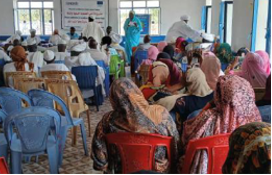
Day one of the conference.
A peace agreement signed at Mershing
The Concordis team facilitated four days of challenging conversations between 169 participants about why the roads were closed, and how they could be re-opened safely without undermining the security concerns of any side in the conflict.
Remarkably, in the face of such entrenched, multigenerational, multi-group conflicts, they were able to find a consensus that was agreeable to all participants. They universally agreed on:
Reopening the roads with strict rules to address banditry and criminality, allowing safe civilian movement and lowering food costs.
Putting in place steps to protect crops.
Creating clear corridors and pasturage for livestock, to be managed by local civic groups with Concordis’ support.
A plan to address future intercommunity disputes with mediation and compensation, not with violence.
Improving water harvesting and storage, providing shared access to reduce tensions.
Movement across territories will take place without weapons - key to protecting women and children. This assures the agreement is acceptable to armed groups – the communities themselves stood surety that, if re-opened, these roads would not be used to give military advantage to any group.
Consensus of all 169 participants
12 different ethnic groups from both herder and farmer communities.
3 Nazirs (kings), 3 Emirs and 61 other traditional leaders.
Civilian representatives of the RSF, the SLA Abdel Wahid and the SLA Minni Minawi.
The representative of the Wali (governor) of South Darfur.
2 RSF-appointed Executive Directors (regional governors).
33 women and 32 youth.
What does this mean?
Success at Mershing means food can be grown and harvested, transported and traded, at a time when 25 million Sudanese people face man-made famine.
Success at Mershing demonstrates that community level peacebuilding is both possible and effective in delivering tangible benefits for the population.
Success at Mershing models what an impactful peace process should look like: inclusive, pragmatic and owned by the people most acutely affected.
Success at Mershing generates an entry point for effective dialogue between protagonists and is a shot in the arm for other stalled peace processes.
Success at Mershing will not end the war in Sudan, but already it has dramatically reduced the impact in South Darfur.
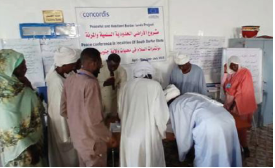
Delegates at Mershing sign the agreement.
What comes next?
Peace is a process, not a single conference. The agreement needed to be disseminated and shared, then implemented and enforced. It needed to be worked out in high-risk areas, and then applied in response to crisis events like SAF’s withdrawal from El Fasher.
The war continues. Other roads have been closed. Other markets have been attacked. And yet the trajectory is going in the right direction, towards peace.
All of this is being managed by eight Concordis staff. Quietly building trust, supporting a network of 315 local peacebuilders across South Darfur.
“Women and children are the first victims of conflict. Let us restore cohesion and rebuild the social fabric.” Fatima Abdulrahman, a woman leader in Mershi.
Want to support this work? Click here to give to Concordis.